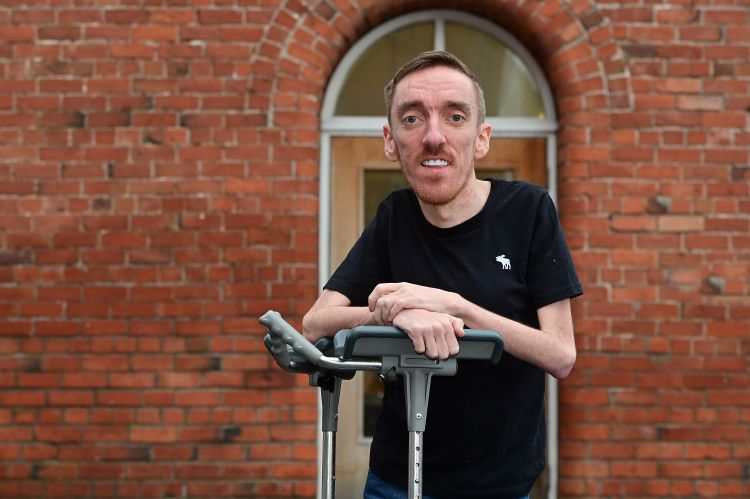
36-year-old Matthew Monaghan was born with a rare neuromuscular condition and was told he would never walk.
Now, Matthew has not only overcome those psychical barriers, but also gone on to become the first disabled pilot to land a plane at Belfast International Airport. He shares his story in his new memoir The Weight of Progress documenting the struggles he has faced from childhood through to adulthood and his journey to becoming a pilot.
Here, we catch up with Matthew to chat about his life and success.
Firstly, tell me about your background. How was life for you growing up?
I was born with a muscle condition that shaped almost every part of my early life. Growing up, things most people take for granted – running, playing, even walking long
distances were a constant challenge. There were a lot of hospital visits, uncertainty, and moments where I felt like life was happening around me rather than with me. But at the same time, I was surrounded by a family who refused to let me be defined by my condition. They pushed for opportunities, fought for me when needed, and treated me as normal as possible. That combination of struggle and support gave me a mindset that I carry with me today.
Can you take me back to the moment you were told you might never walk. How did you feel?
It’s a strange moment to describe because, in a way, it wasn’t a single dramatic event – it was something that was reinforced over time through conversations, limitations, and expectations. But hearing it clearly, that walking might not be something I’d ever do independently, was incredibly heavy. At that age, you don’t fully process the long-term implications, but you do feel different. You feel like your path has already been decided for you. There was frustration, confusion, and a sense of loss for something I hadn’t even properly experienced yet.
What was the turning point when you decided you wouldn’t accept limits placed on you?
The real turning point came later in life, when I started to question whether those limits were absolute – or just assumptions. I realised that a lot of what I’d been told wasn’t necessarily impossible, it was just unlikely or difficult. That shift from “I can’t” to “what if I can?” changed everything. It didn’t happen overnight, but once I started testing those boundaries, even in small ways, it built momentum. I stopped seeing my condition as the end of the story and started seeing it as just one part of it.
At what point did becoming a pilot go from dream to real possibility?
Flying started as something that felt completely out of reach – almost symbolic of freedom rather than something I could actually do. But the moment I got the opportunity to try it,
everything changed. Sitting in the cockpit for the first time, I realised that this wasn’t just a dream – it was something I could physically do, adapt to, and learn. From that point on, it became a goal. And once it became a goal, I committed to it fully.
What does being the first disabled pilot to do this mean to you personally?
It means everything, but not just for the achievement itself. For me, it represents a shift in what’s possible – not just for me, but for others who might see themselves in my story.
I never set out to be “the first” for recognition. I set out to prove to myself that I wasn’t defined by limitations. But if that journey helps someone else rethink what they’re capable of,
then that’s where the real value lies.
What’s next for you after this milestone and your memoir launch?
The memoir is really just the beginning. My focus now is on sharing this story on a bigger scale – through public speaking, media, and continuing to build a platform that inspires
people to rethink their own limits. I want to step into motivational speaking in a serious way, working with organisations and audiences who are facing challenges of their own. At the same time, I’ll continue flying and pushing myself further, because for me, progress doesn’t stop at one milestone – it’s an ongoing journey.
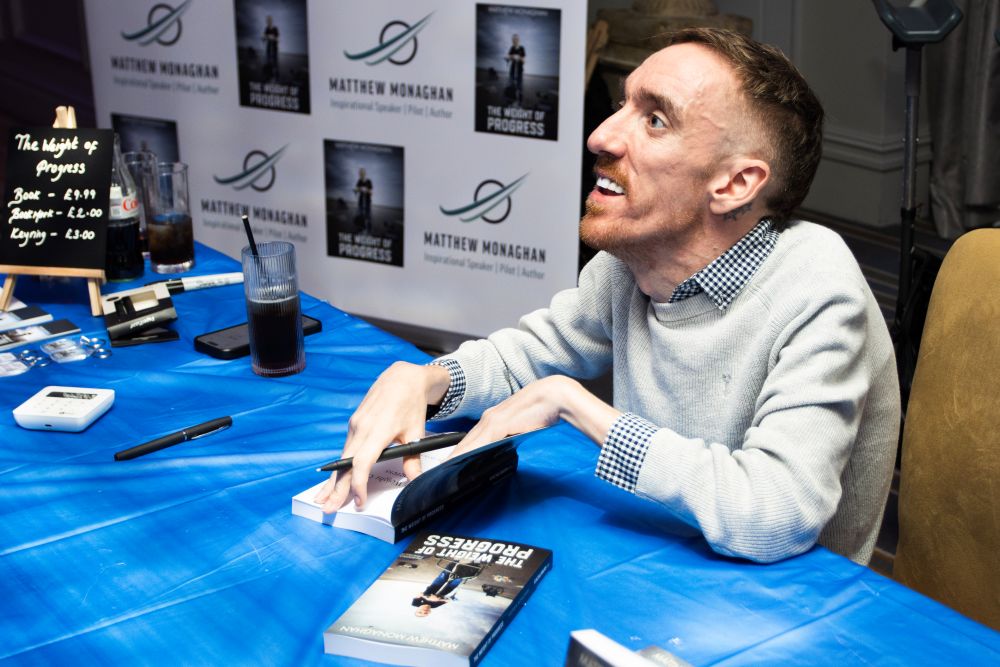
Matthew Monaghan’s The Weight Of Progress is out now.