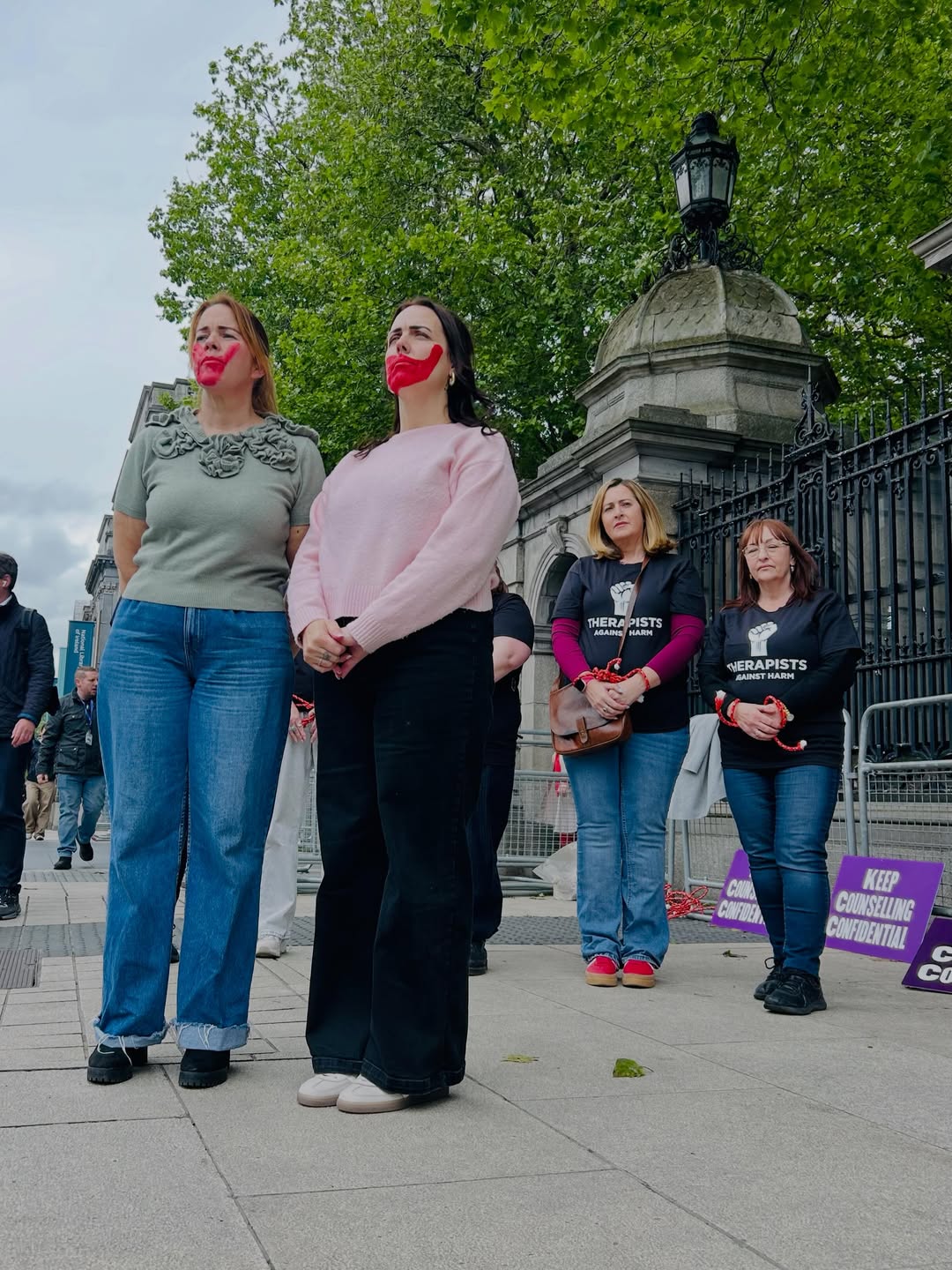
It came to light this week that the government will not enact an all-out ban on sharing counselling notes in criminal sexual assault trials.
During a Dáil debate earlier this week, the issue of banning the use of counselling notes during legal proceedings involving rape and sexual violence was put to Minster for Justice Jim O’Callaghan. O’Callaghan has proposed reforms to the law to ensure that sensitive material is only used when deemed completely necessary, and at the discretion of the judge. This proposal comes to the disappointment of outreach groups, who have been lobbying for an all-out ban.
The use of confidential counselling notes of sexual violence survivors in criminal trials has been repeatedly slammed by outreach groups as incredibly retraumatising, it has also been recognised as a significant deterrent for survivors seeking valuable support. Acting Editor, Niamh Devereux covered this topic in her ‘The Invisible Struggle‘ series, in a three-part special on violence against women. She spoke with co-founder of ‘Éist – Saying No To Silence’, Hazel Behan, also a survivor, who shared why the group is on a mission to see this practice banned.
“It’s an abuse of your human rights”, she commented. “These are private thoughts trying to process extreme pain. The counsellor’s interpretations of your thoughts and feelings are cherry picked and used against you in court to discredit you. The counsellor isn’t even brought into the court to give the notes context”.
During a speech at the launch of the Dublin Rape Crisis Centre’s 2025 Annual report on Tuesday, Minister for Justice Jim O’Callaghan said “disclosure of counselling notes or other sensitive records should only occur where absolutely necessary, subject to rigorous judicial scrutiny, and with survivors’ rights and dignity fully protected”. He also made it clear that he would be proceeding with his own amendments to the legislation despite concerns from both survivors and advocacy groups.

The aforementioned report shows that 2025 was the DRCC’s busiest year on record, outlining that its National Helpline had 23,995 contacts last year and supported 838 people in therapy, an increase of 31.5% on 2024.
We caught up with Hazel Behan again following the recent Committee deliberations surrounding the proposed amendments relating to counselling notes in sexual violence trials. She told us: “What unfolded before us at Committee level was profoundly disheartening. TDs who had taken the time to engage with survivors and therapists spoke passionately about the very real psychological danger in these proposals, yet those warnings were ultimately disregarded. Survivors across this country feel angry, unheard and deeply let down once again.
“Therapy is not evidence. It is not a crime scene. It is a lifeline. Yet survivors are still being told that their most vulnerable moments, disclosed in confidence while trying to stay alive and move forward in their lives, may ultimately be opened, examined and used against them in court by the person they believe harmed them. The chilling effect of that cannot be overstated”.
According to the CSO 40% of the adult population in this country has experienced sexual violence in their lifetime and yet only 5% disclose this to others or report it to the police, with even fewer cases moving to prosecution.

The Psychological Society of Ireland has said there is critical need for counselling following sexual violence, “Psychologists and mental health professionals regularly witness the profound psychological consequences of sexual violence”. It has condemned the use of therapy notes in court proceedings saying: “This practice undermines the therapeutic process and may influence individuals in need of support to not engage with mental health services for fear that their private disclosures could later be accessed and used against them in a court of law”.
The DRCC has added that it utterly opposes the use of counselling notes in this way. Hearing directly from survivors they support, a representative said “it is one of the cruellest, most retraumatising and degrading aspects of an incredibly arduous and adversarial wider criminal justice system”.
According to research by the Law Society of Ireland’s Centre for Justice and Law Reform, the average number of sexual offences reported in Ireland between 2019 and 2023 was 43% higher than the EU average. We are seeing a significant portion of our population subject to these horrific crimes with only a fraction being reported, hence the government being lobbied to remove on of the most significant barriers to support for victims and survivors.
As survivor and legal advocate Sandra Daly – also co-founder of Éist – previously told Irish Country Magazine: “In all other trials, there’s a rule where no evidence can be admitted on hearsay. Yet, only for sexual violence trials, we allow these notes in. The whole process is another way of silencing survivors; it prevents people from pursuing justice. If I’m honest, I think we will have to go to the European Courts of Justice to resolve this. And we will.”
Éist is offering a free Zero Tolerance Pledge Online Workshop, open to individuals, businesses, and organisations nationwide. It is designed as an accessible starting point for those who want to better understand what a Zero Tolerance approach to sexual and gender-based violence looks like in practice, and how it can be reflected within communities, workplaces, and organisations. To sign up, click here.