New data shows that urinary incontinence continues to be an invisible struggle in women’s lives
The misconception that urinary incontinence (UI) is a ‘normal’ part of life for women continues. Today, the Continence Foundation of Ireland (CFI) has announced new nationally representative research that reveals the extent to which urinary incontinence affects women in Ireland — and how few seek the help that could significantly improve their quality of life.
The research has found that almost two-thirds of Irish women (64%) have experienced urinary incontinence at some point in their lives. The condition is most likely to begin after childbirth, highlighting the importance of postnatal pelvic health care and awareness. Despite its prevalence, just half of women who have ever experienced urinary incontinence (51%) have spoken to a healthcare professional about their symptoms.
It also highlights the emotional impact of the condition: just under two in five women (38%) say they would feel comfortable discussing urinary incontinence with a family member or friend, underscoring how hidden and isolating the issue can be.
“Far too many people stay silent because they feel embarrassed, worry about being judged, or assume that bladder leakage is just a normal part of getting older or having children. It isn’t,” says Dr Breffini Anglim O’Regan, President of the Continence Foundation of Ireland and Consultant Obstetrician, Gynaecologist and Urogynaecologist at The Coombe Hospital. “Incontinence is a medical issue — and a very treatable one. The biggest barrier we see is not the condition itself, but the belief that nothing can be done. Once women seek help, treatment can be can be life-changing.”
She continues: “These findings confirm what we see every day in clinics — urinary incontinence is extremely prevalent, yet deeply hidden. No woman should feel she has to just ‘live with it’. Treatment is available, and early assessment can make a profound difference. We want women to know that support exists, and seeking help is a positive and empowering first step.”
CFI (continence.ie) is urging women across Ireland to recognise that incontinence is common but not something to be ignored, talk to a healthcare professional if symptoms occur and learn more about treatment options and support.
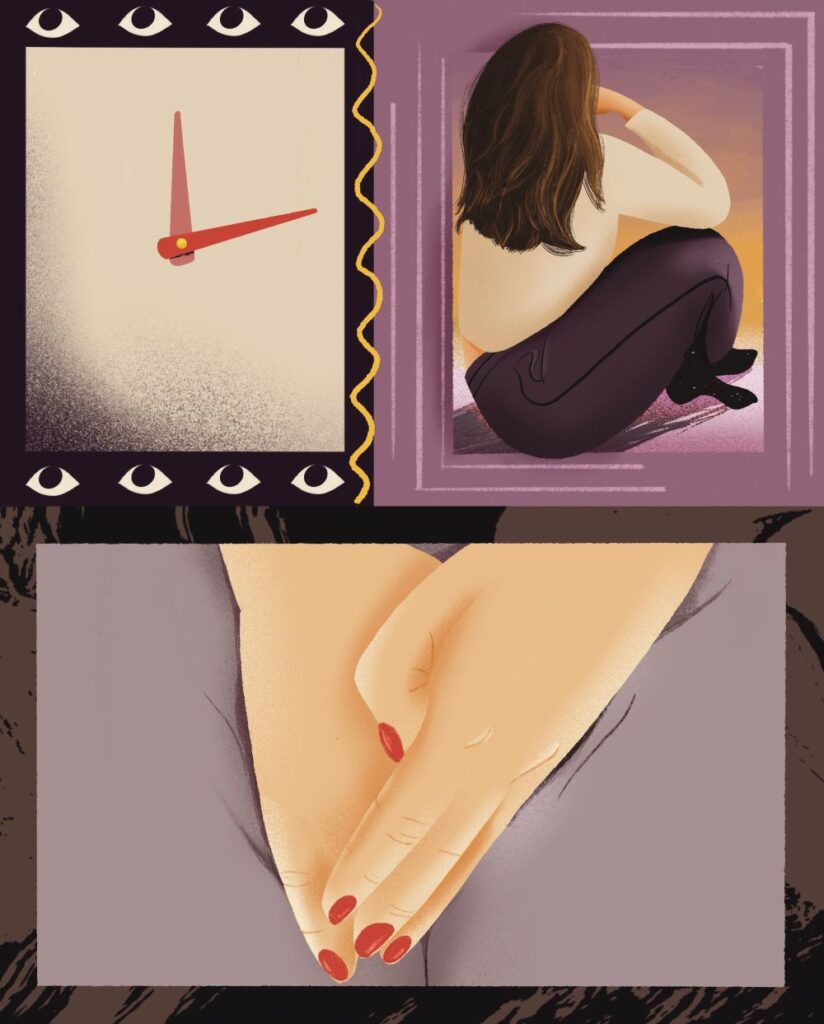
For a previous feature in our health series The Invisible Struggle (illustration above by Sarah Gray), I spoke with Dr. Gerry Agnew, a Consultant Urogynaecologist at the National Maternity Hospital, St. Vincent’s Hospital and the Pelvic Floor Centre at St. Michaels’ Hospital for expert advice.
He said the first port of call if you are experiencing UI symptoms is to make an appointment with a Women’s Health Physiotherapist for assessment and a management plan. “They will identify the type or types of incontinence a woman is experiencing, and they will also be able to determine if vaginal prolapse is a factor. They can then tailor lifestyle advice to that unique individual. If, after six months, they are still symptomatic, the woman should ask to be referred to a Urogynaecologist or a Urologist who has an interest in Female Urology,” he says.
Laura Dowling, known to many as The Fabulous Pharmacist, also told me how she regularly meets women suffering in silence from UI. “I’ve done corporate talks for years, and anytime I’ve spoken about incontinence, you could hear a pin drop in the room,” she says. “I always had people come up to me afterwards to say they’d be struggling with it for 15 years; that they were too ashamed to tell their husband, even their doctor. They were scared they’d be thought of as old, smelling of wee.”
In an attempt to tackle the stigma surrounding women’s health issues, Laura released a fantastic book called Love Your Vulva and breaks down stigma further in her tour Viva La Vulva (the next is in Dublin’s National Concert Hall on 31 January) with women aged “23 to 86” attending. “Each show featured women suffering from UI. Two out of three never had babies…one woman had incontinence since she was a teenager and it has been detrimental to her sex life and exercise. She broke down in tears as she didn’t know where to turn.”

“This is the thing,” she adds. “We’re always told to exercise, how it’s great for our bones and our health – but how can a woman exercise when she’s wetting herself after walking five metres?”
Laura echoes Dr Agnew’s advice to make an appointment with a Women’s Health Physio to tackle this. “It shouldn’t be normalised that we need to wear pads. It should be that pads are there to help women, but they need to know the right pelvic floor exercises for them. Do you know that in France, women get free physical therapy sessions after giving birth? Whereas in Ireland, you’re sent off with your baby to figure it out yourself.
“We don’t look after our vaginal and pelvic health and women suffer as a result; both in the immediate post-partum period and in the years to follow. If you get seen to earlier and get the right exercises, there’s a better outcome. You need to pay for a private physio, but I think it’s the best €100 a woman can spend on herself.”
Laura adds: “I always say to women: if this was your husband, wouldn’t you tell him to get it seen to? Why are you accepting it for yourself? I always think if men were going through this; there’d be free medicine for them, in dispensers on every street. But because it’s “women’s issues”, we should be quiet and not talk about our vaginas because it’s a bad, shameful word. It’s only when we talk about it and give out about it that we’ll get seen to. The thing is, the policy makers are mostly men. And I love men, but we need to be more open about what happens to women’s bodies and how we can help women.”
Laura credits vaginal oestrogen as a hugely important factor in helping women she has encountered in her work, and she feels passionately that this should be available to Irish women over-the-counter, as it is currently prescription-only. Dr Agnew notes that while this is unlikely to cure women complaining of significant urinary incontinence, vaginal oestrogen is a highly recommended treatment for general vaginal health and can improve female urinary symptoms of urgency, recurrent urinary tract infections and stress incontinence.
For more on our award-winning health series The Invisible Struggle, pick up the January|February edition of Irish Country Magazine now, which tackles Seasonal Affective Disorder, commonly known as SAD.