The winner of our current Short Story Competition is published in the November issue of Irish Country Magazine, on shelves now. ‘The Spark’ by Paula Galvin came in second place.
Read Paula’s story below:
The white page dazzled her with its whiteness, with its blankness. “C’mon just write a few words, a first sentence, then a second one…if it is rubbish, just bin it, start again!” It admonished her.
“You have done enough creative writing workshops, so write” She knew those niggling, insistent voices were right, she would have to find something, a light, a flicker, even a little glimmer. It might justify all those hours she had spent, listening to the wisdom of others, encouraging gently to keep writing every day, make it a habit even. They had cost her too, probably in the range of a few grand if she had included travel and accommodation.
She had bought a beautiful pen in one of those lovely stationery shops you find when you are wandering aimlessly on holidays. It had textured papers, pens of every hue, beautiful notebooks and was on a cobbled street in Seville, near the cathedral. She had gone looking for one of those “authentic” tapas bars Anthony Bourdain had mentioned in one of his programmes, while her husband stayed in their apartment on an orange tree- lined street. The setting, the streets, the smells, the Flamenco dancing had all the right ingredients for a story or a poem or even a memoir.
She had lots of unfinished things, things that would be completed when she retired or when she came back from a trip. She flicked through the haphazard pile of notebooks she had picked up over decades. Some sentences had seemed promising, some had even been witty, but she lacked the motivation or the self-belief to make them into something more solid, more coherent, more interesting.
She had heard writers speak about how a certain voice or scene or piece of furniture had stayed with them demanding to be included in a piece of writing. She had always thought that had sounded vaguely ridiculous not to mention pretentious.
She sat in what she laughably described as her study. The only study that went on in there was the study of the labels on the bottles of wine she kept hidden in the drawer of the desk. Occasionally she read, but once the wine kicked in and the words began to dance and double before her eyes, she could not make sense of the story.
She felt a bit cold and decided although it was August that she would light a fire. As a child, she had loved the ritual of chopping sticks with an axe in the back garden, the satisfying split and crack of the wood, the gathering together of the pieces in an old bucket. Taking the Sunday newspaper from where it had been thrown on the armchair where her dad had read it while smoking his pipe, she carried it towards the open grate. It had not been cleaned out so the dusty, mucky job was left to her. She hated the scrape of the shovel on the hearth and the cloudy puffs of ash which made her eyes sting and caught in her throat.
But the satisfaction of that empty, clean grate welcomed her in its embrace. The newspaper was rolled tightly, diagonally and then twisted into tight doughnuts, a little piece dangling like a tail at the end. She always aimed to have twelve of these. They were laid out in rows, overlapping slightly. The sticks were laid on top, verticals first, then the horizontals leaving plenty of space so that the fire once going, would whoosh greedily through these pockets of oxygen. Finally, and ceremoniously, the coal was placed gently on top, the smallest nuggets first and then the bigger ones, gleaming oleaginously. The Maguire and Paterson matches were kept in a drawer of the kitchen table which still bore the rings of cups of tea on its flowery oilcloth.
She struck the match, breathing in the smell of sulphur and anticipating that first glow. She held it close to the newspaper and watched that first flame flicker, catch and travel like a Zephyr through the doughnuts. She heard the first crackle as the first stick caught and felt her hands warm as she fanned them above the fire. “Be sure and put the fire guard up and don’t throw anything on the fire!” her Mam always told her and most of the time she complied. But today, with her Mam and Dad out of the house, she felt emboldened. She had seen her Mam sometimes sprinkle sugar on the fire when it did not catch. She took the white and pink Siucra bag from the second shelf of the press. She took a handful and sprinkled the white crystals on the fire. The flames leapt up, burning her thumb and index finger. She stuck them into her mouth, sucking furiously until the pain subsided slightly. Then she plunged her hand into the bag grabbing a handful of its crystals. The pain this time was unimaginable and the sugar had melted onto her fingers. She elbowed the tap to turn it on with her left side and held her throbbing hand under the cold water. She returned white-faced and shaking to see the fire sputtering to a close and the Siucra bag disintegrating. She would not tell her parents about the burn, but they would wonder where the bag of sugar had gone. Dad always had four spoons in his tea.
They had eaten so much sugar in those days, no wonder their teeth were bad and the smoking too. Their mouths must have been fetid. How had they kissed each other, she wondered.
It was too late to light a fire. She closed the curtains and sat on her swivel chair. She thought about opening a bottle of Vino de Naranja which she had brought back from Seville. But her memories had sparked something in her.
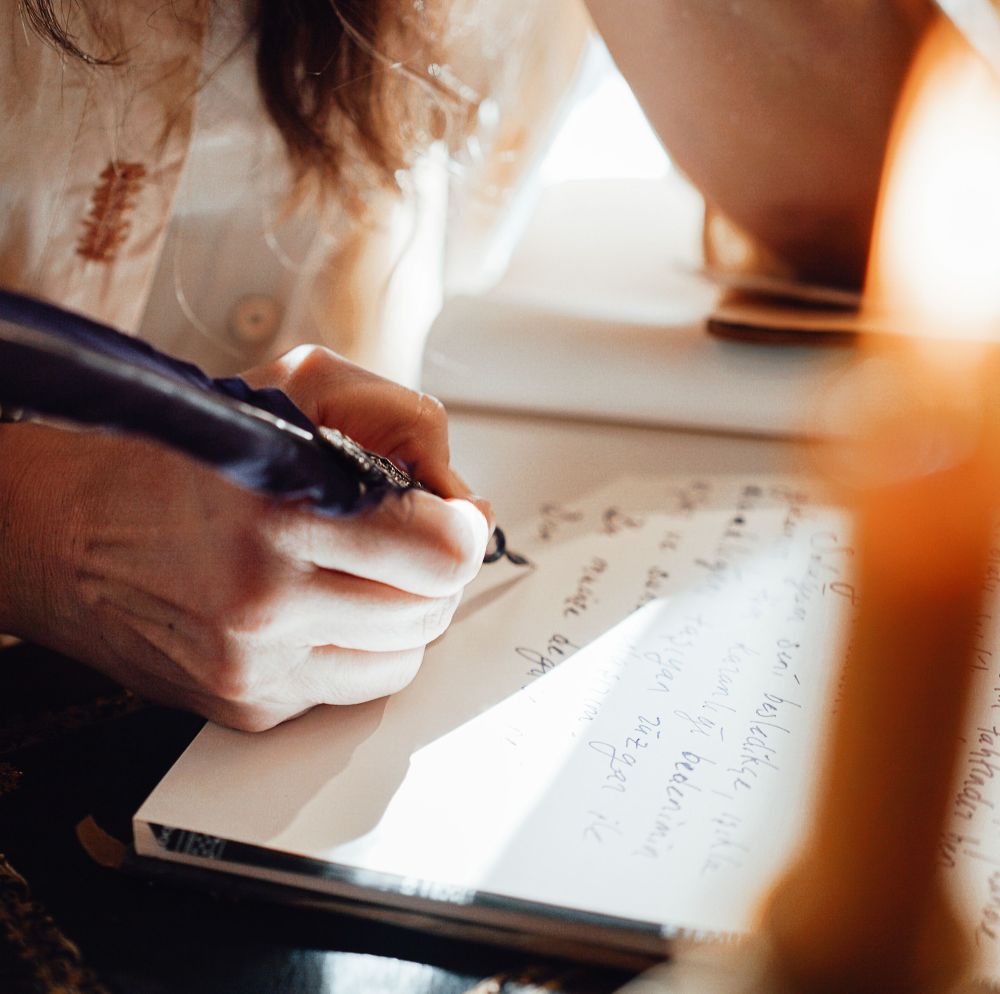
She took the lid off her pen and began to write.
Click here for details on how to enter our next competition.